

Stress & Distortion During AM
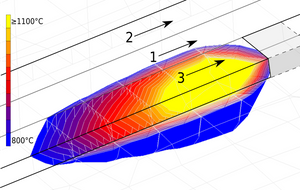
Combined metallurgical and flow-stress models help predict stress and distortion during additive manufacturing of Ti-6Al-4V.
Written by
Bijish Babu
Published
Topics
- FEM
- Manufacturing
- MatMod
Read the full article on LinkedIn
Simulating the additive manufacturing process of Ti-6Al-4V is very complex owing to the microstructural changes and allotropic transformation occurring during its thermo-mechanical processing. The α-phase with a hexagonal close pack structure is present in three different forms; Widmanstatten, grain boundary, and Martensite. A metallurgical model that computes the formation and dissolution of each of these phases is used here. Furthermore, a physically based flow-stress model coupled with the metallurgical model is applied in the simulation of an additive manufacturing case using a directed energy deposition method.
The full article can be downloaded from the link below.
Download the paper (PDF, 2.4 MB) — © the authors, CC BY 4.0
Originally published by Bijish Babu on LinkedIn: Prediction of Stress & Distortion During Additive Manufacturing of Ti-6Al-4V