

Modeling Plastic Deformation
An introduction to the crystalline mechanisms and defects that shape plastic deformation and the mechanical response of metals and alloys.
The George Washington University
Written by
Bijish Babu
Published
Topics
- MatMod
- Materials Science
Mechanical properties of metals and alloys are closely related to its crystalline structure. Understanding the formation of crystalline defects (vacancies, dislocations, grain boundaries, inclusions, etc.) during thermo-mechanical processing is of utmost importance in predicting and controlling the mechanical properties of a material.
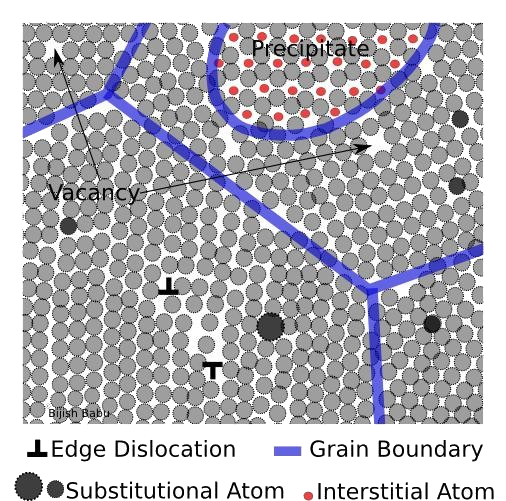
Plastic deformation in metallic materials occur by motion of dislocations. Dislocations interact with each other and also with other defects depending on the thermal and mechanical energy available leading to a multitude of mechanisms like slip, climb, recrystallization, etc. and their complex combinations.
Based on the rate of deformation and temperature, the deformation mechanisms vary, thus altering the resistance to deformation. A higher rate of deformation demands a larger force whereas higher temperature lowers the force.
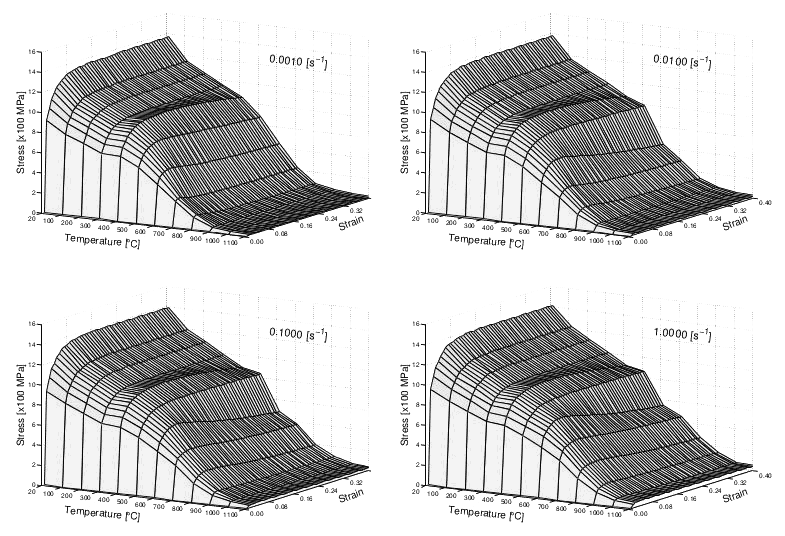
A constitutive model for elasto-plastic deformation taking into account of the microstructure and phase change is of utmost importance in simulation of hot/cold metalworking processes.
For more information: Dislocation density based model for plastic deformation and globularization of Ti-6Al-4V
Originally published by Bijish Babu on LinkedIn: Modelling the physics of plastic deformation.