

Microstructure Evolution
Modelling the substantial changes in microstructure and material properties that develop throughout industrial hot rolling.
NLMK Group
Written by
Bijish Babu
Published
Topics
- Manufacturing
- MatMod
Hot rolling is the process of manufacturing thin sheets from thick slabs by the process of passing them between rolls back and forth and in tandem. During this process, the material undergoes substantial changes in its microstructure and properties.
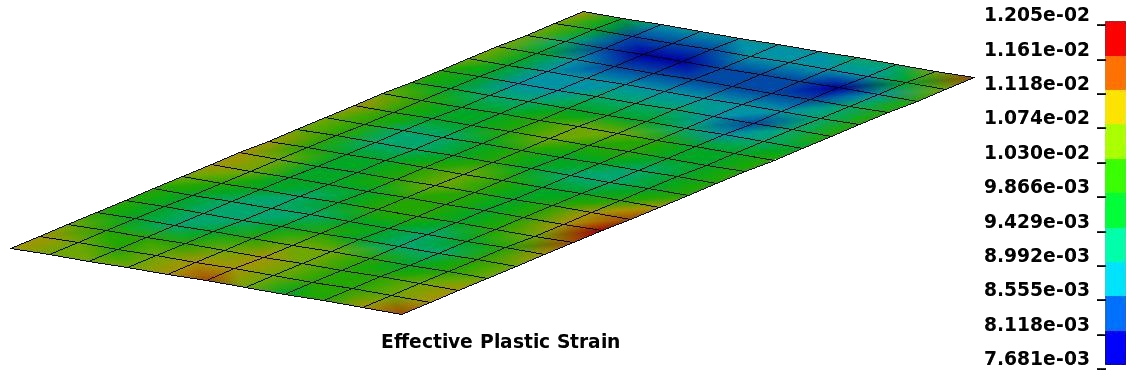
Final Plastic Strain from thermal loads & transformation plasticity (strains from rolling is ignored here)
FEM simulations can be used to predict the final shape and properties thereby enabling process optimization. Modeling the microstructure and its coupling with mechanical properties is of utmost importance in this context.
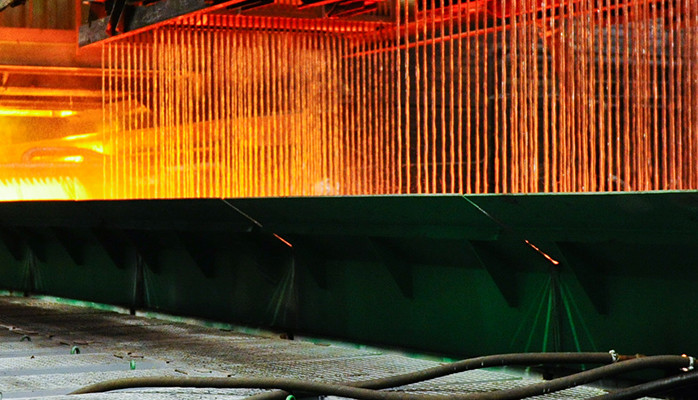
After hot rolling, the sheet metal passes through a runout table where it is cooled at a prescribed rate to obtain desired microstructure and mechanical properties. Runout table consists of arrays of nozzles which spray water onto the sheet from both sides. In this work, each array is modelled by applying heat flux on the surfaces of the strip. Only a part of the strip (2m long) is modelled here since the results are symmetric throughout. Though the strip is stationary, the moving boundary conditions applied in a sequential manner, enables simulation of the whole strip passing through the length of the mill and predict the final shape (flatness) and residual stresses of the finished product.
(History Variable 6: Austenite Phase Fraction, 7: Ferrite and 8: Bainite)
Phase transformation behavior of steel during cooling is of great importance while deciding the mill pass schedule. This is because the cooling rate of the steel has dominant effect on the final grain size, phase composition and morphology. Increasing the cooling rate leads to higher nucleation rate and a finer ferrite grain size. If the cooling rate exceeds a critical value, the transformation can change from diffusional to displacive, forming the martensite phase and/or bainite phase for intermediate cooling rates.
For more infomation regarding the material model see: P Åkerström etal 2007 Modelling Simul. Mater. Sci. Eng. 15 105, http://dx.doi.org/10.1088/0965-0393/15/2/007 and LS-DYNA material model MAT-244
Originally published by Bijish Babu on LinkedIn: Microstructure and Property Evolution in a Runout Table